
AI Mock Interviews vs Traditional Interview Preparation: Which Is Better?
Discover how AI mock interviews compare with traditional interview preparation and learn how both approaches can help you prepare more effectively for your next interview.
Compare Both →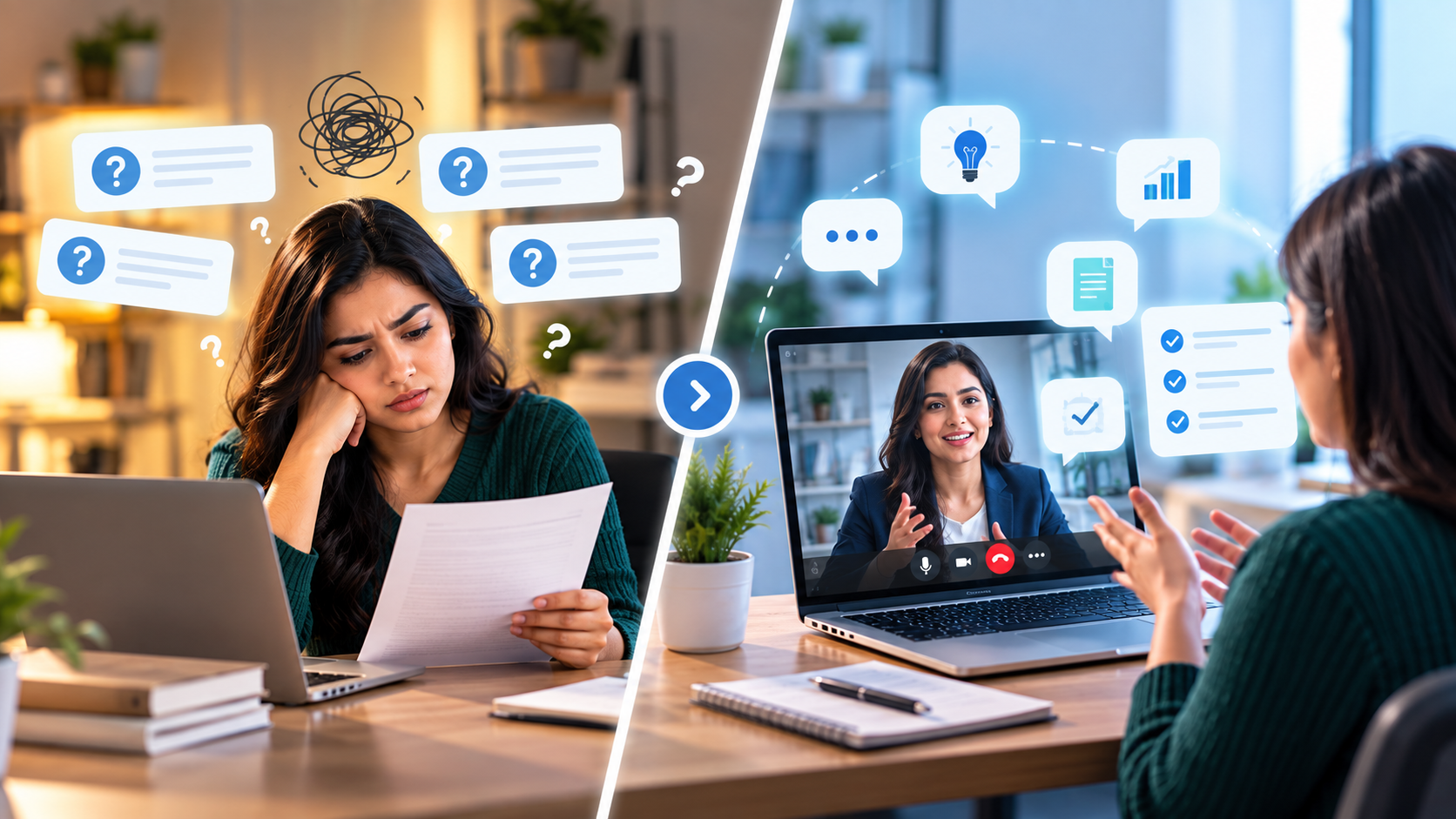
Quick answer: AI mock interviews are particularly useful for frequent, flexible, and repeatable interview practice, while traditional interview preparation can provide valuable human perspective, mentorship, and interpersonal feedback. For many candidates, combining both approaches can provide stronger preparation.
Preparing for a job interview has traditionally meant reviewing common questions, researching the company, practicing answers in front of a mirror, or asking a friend, mentor, or career coach to conduct a mock interview.
Those methods can still be valuable. But AI-powered interview preparation is changing how students, freshers, and job seekers practice before an interview.
With AI mock interviews, candidates can practice interview questions, improve their responses, identify areas that need work, and repeat the process whenever they need more preparation.
So, when comparing AI mock interviews vs traditional interview preparation, which approach is better?
The answer depends on what you need to improve.
What Is Traditional Interview Preparation?
Traditional interview preparation includes the methods candidates have used for years to prepare for job interviews.
These may include:
- Researching the company and job role
- Reading common interview questions
- Writing or rehearsing answers
- Practicing in front of a mirror
- Asking friends or family members to conduct mock interviews
- Participating in college placement mock interviews
- Practicing with mentors or career counsellors
- Reviewing technical or role-specific questions
These methods help candidates understand what an interview may involve and organize their thoughts before meeting an employer.
However, simply reading interview questions is different from actually answering them.
You might understand a question perfectly while reading it but struggle to structure your response when someone asks it unexpectedly.
That is where mock interview practice becomes important.
What Is an AI Mock Interview?
An AI mock interview uses artificial intelligence to simulate aspects of a real job interview.
Instead of only reading questions and thinking about possible answers, candidates can actively practice responding to interview questions in a structured environment.
Depending on the platform, an AI interview preparation tool such as Prep2Hire may help candidates practice:
- General interview questions
- Behavioural questions
- Role-specific questions
- Technical questions
- Situational questions
- HR interview questions
- Communication and answer structure
The goal is not to predict every question a recruiter will ask.
The goal is to become more comfortable thinking, organizing ideas, and responding clearly when faced with interview questions.

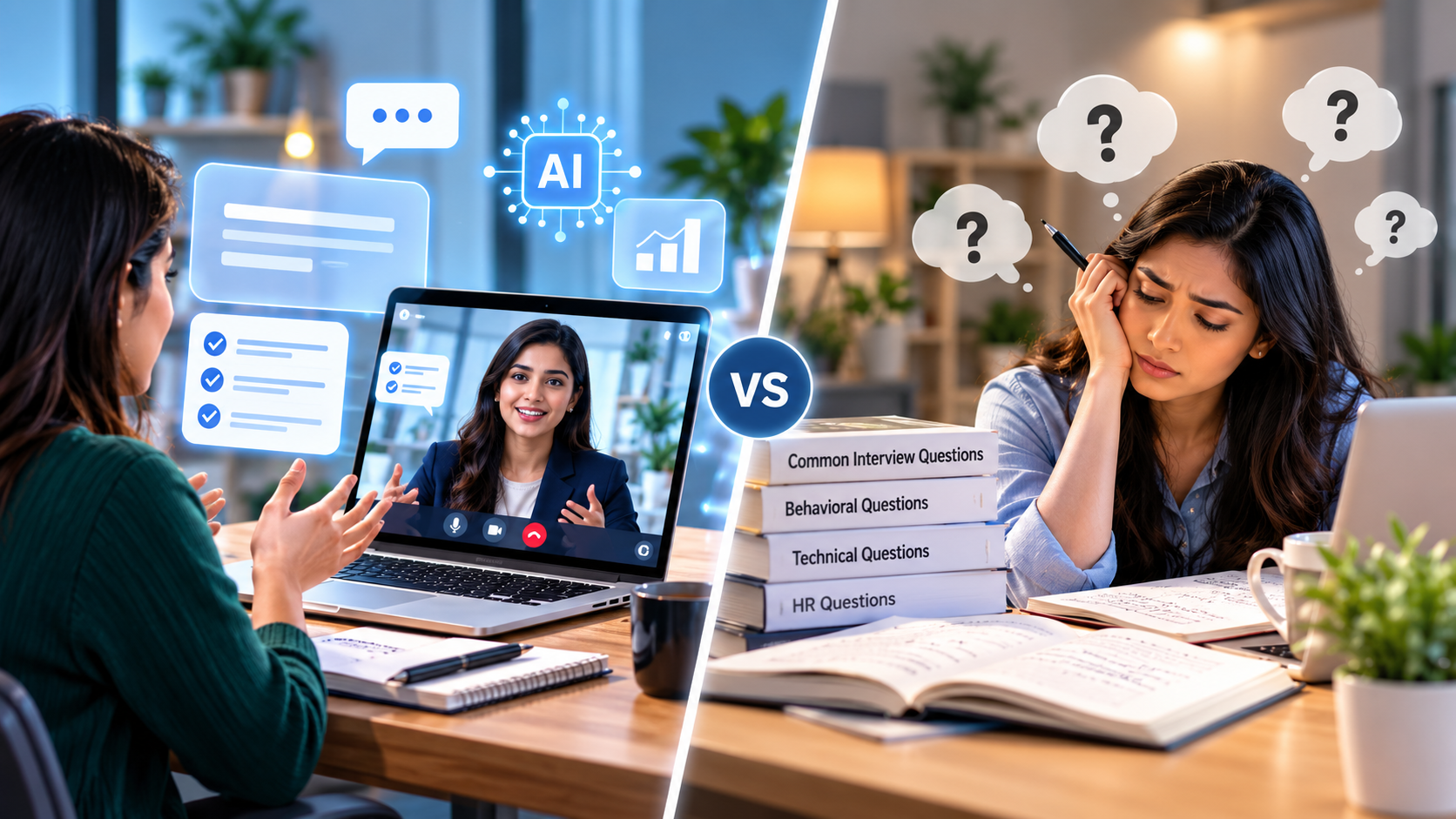
AI Mock Interviews vs Traditional Interview Preparation
Here is a simple comparison.
| Feature | AI Mock Interviews | Traditional Preparation |
|---|---|---|
| Practice availability | Often available on demand | Depends on another person's availability |
| Repeated practice | Easy to repeat | Can be difficult to arrange repeatedly |
| Interview simulation | Interactive | Depends on preparation method |
| Feedback | Can provide structured feedback depending on the tool | Human and experience-based |
| Personalization | Can adapt based on role or inputs | Depends on mentor/interviewer |
| Convenience | Practice from almost anywhere | May require scheduling |
| Human perspective | Limited | Strong |
| Practice consistency | High | Can vary |
| Best suited for | Frequent independent practice | Human feedback and mentoring |
Both approaches have strengths. The important question is how effectively each method helps you become interview-ready.
7 Ways AI Mock Interviews Can Improve Interview Preparation
1 Practice Whenever You Need It
One of the biggest challenges with traditional mock interviews is coordinating with another person.
Your mentor may be busy.
Your college placement team may only conduct a limited number of sessions.
Friends may not know what questions are relevant to your target role.
AI mock interviews can make practice more accessible because candidates can prepare when it fits their schedule.
This can be especially helpful for students balancing classes, assignments, internships, exams, and job applications.
2 Turn Passive Preparation Into Active Practice
Reading interview questions is useful, but interviews require you to respond in real time.
Consider this common question:
“Tell me about a challenge you faced and how you handled it.”
When reading the question, you may immediately think, “I know how to answer that.”
But when you need to explain the situation clearly, describe your actions, and communicate the result, answering can become much harder.
Mock interviews force you to practice the skill rather than simply study it.
3 Practice Difficult Questions Repeatedly
Some questions require more practice than others.
For example:
- Tell me about yourself.
- Why should we hire you?
- What are your strengths and weaknesses?
- Tell me about a failure.
- Describe a conflict you faced.
- Why do you want this job?
- Where do you see yourself in five years?
With traditional preparation, candidates may practice these questions only a few times.
AI-based interview practice can make repetition easier.
You can work on an answer, identify weaknesses, improve it, and try again.
Repeated practice can help candidates develop clearer and more structured responses.
4 Prepare for Behavioural Interview Questions
Behavioural questions can be challenging for students and freshers because they may believe they need years of professional experience to answer them.
That is not necessarily the case.
Students can often draw examples from:
- Academic projects
- Internships
- Hackathons
- College clubs
- Volunteer activities
- Competitions
- Freelance projects
- Team assignments
- Leadership activities
A useful structure for answering behavioural questions is the STAR method:
Situation: Explain the context.
Task: Describe what you needed to accomplish.
Action: Explain what you personally did.
Result: Describe the outcome.
Practicing this structure repeatedly can make behavioral answers easier to organize during an actual interview.
5 Build Confidence Through Repetition
Interview anxiety often comes from uncertainty.
Candidates may worry about:
- What questions will be asked
- Whether they will forget their answers
- How clearly they will communicate
- Whether their answers are too long
- How they will respond to unexpected questions
You cannot eliminate every surprise from an interview.
But you can become more comfortable answering questions you have not memorized.
Regular mock interview practice helps candidates focus less on memorizing perfect sentences and more on communicating their experiences naturally.
6 Identify Weak Areas Before the Real Interview
Interview preparation is most effective when you understand what needs improvement.
For example, you may discover that:
- Your introduction is too long.
- Your examples lack measurable outcomes.
- Your answers are too generic.
- You struggle with behavioral questions.
- You don't explain your projects clearly.
- You use too many filler words.
- Your answers don't connect to the job description.
Discovering these issues during practice gives you an opportunity to improve them before speaking with a recruiter.
7 Make Interview Practice More Consistent
Many candidates prepare intensely one day before an interview.
A better approach is to practice gradually.
Day 1: Practice “Tell me about yourself.”
Day 2: Practice behavioural questions.
Day 3: Practice questions related to your projects.
Day 4: Practice role-specific questions.
Day 5: Complete a full AI mock interview on Prep2Hire.
This creates a structured interview preparation routine instead of relying on last-minute preparation.
Where Traditional Interview Preparation Still Has an Advantage
AI mock interviews can be useful, but they should not completely replace human interaction.
There are areas where traditional mock interviews remain especially valuable.
Human Feedback
An experienced recruiter, mentor, professor, or career coach may notice nuances that an automated system may not fully capture.
They may provide feedback about:
- How convincing your answer sounds
- Whether your example feels relevant
- How you respond to follow-up questions
- Your interpersonal communication
- Whether your personality comes across naturally
Industry Experience
A mentor who has worked in your target industry may understand expectations that go beyond generic interview preparation.
For example, interviewing for a software engineering position can be very different from interviewing for marketing, sales, finance, or product management.
Real Human Interaction
Ultimately, most job interviews involve interacting with another person.
Learning how to listen carefully, understand conversational cues, ask thoughtful questions, and build rapport remains important.
That is why human practice continues to have value.
AI Mock Interviews vs Human Mock Interviews: Which Should You Choose?
You do not necessarily need to choose.
A practical preparation strategy can combine both.
Step 1: Research the Role
Study the job description carefully.
Identify:
- Required skills
- Responsibilities
- Technologies or tools
- Qualifications
- Important keywords
Step 2: Prepare Your Resume
Your interview questions will often be influenced by what you include on your resume.
Make sure you can confidently explain every:
- Skill
- Internship
- Project
- Certification
- Achievement
If you are still preparing your resume, read our guide on how to make your resume ATS-friendly in 2026 .
You should also review the most common resume mistakes freshers make before submitting applications.
Step 3: Start With AI Interview Practice
Use Prep2Hire AI mock interviews to practice common, behavioural, and role-specific questions repeatedly.
Focus on improving:
- Answer structure
- Relevance
- Clarity
- Examples
- Confidence
Step 4: Practice With a Human
Once you become comfortable answering questions, conduct a mock interview with a mentor, friend, faculty member, recruiter, or career counsellor.
Ask them to focus on your communication and overall interview presence.
Step 5: Practice Again
Take the feedback you received and complete another round of mock interview practice.
This creates a useful cycle:
Why AI Mock Interviews Can Be Especially Useful for Freshers
Fresh graduates often face a difficult situation.
Employers want candidates who can communicate confidently, but students may have had very few professional interviews.
Without interview experience, it can be difficult to know:
- How much detail to provide
- Which examples to choose
- How to discuss academic projects professionally
- How to answer behavioural questions
- How to explain limited work experience
- How to respond when they don't know an answer
Mock interview practice provides a lower-pressure environment where students can develop these skills before facing an actual recruiter.
With Prep2Hire, freshers can practice introductions, project explanations, and behavioural questions as often as they need before their first real interview.
Common Mistakes to Avoid When Using AI for Interview Preparation
AI interview tools are most useful when they help you improve your thinking—not when they write answers for you to memorize.
Memorizing AI-Generated Answers
A perfectly written answer may sound unnatural when spoken.
Instead, use AI-generated suggestions to understand how an answer could be structured and then explain the experience in your own words.
Practicing Only Easy Questions
Do not repeatedly practice questions you already answer comfortably.
Spend more time on questions that make you hesitate.
Giving Generic Answers
Your strongest interview answers should reflect your actual experiences.
Use examples from your projects, internships, education, leadership activities, achievements, and challenges.
Ignoring the Job Description
Interview preparation should be relevant to the position you are applying for.
Generic preparation is useful, but role-specific practice is usually more valuable.
How Students Can Create a Complete Job Preparation Strategy
Interview preparation should not begin only after receiving an interview invitation.
A stronger job-search process connects each stage:
Start by creating a resume that clearly communicates your skills and experience.
Next, make sure your resume is structured so recruiters and Applicant Tracking Systems can understand it.
Then build a professional online presence where recruiters can explore your projects, certifications, achievements, and experience beyond the limits of a resume.
Finally, practice explaining those experiences through mock interviews.
Your resume may help you reach the interview.
Your interview preparation helps you communicate why you deserve the opportunity.
Final Verdict: AI Mock Interviews or Traditional Interview Preparation?
There is no universal winner.
Traditional interview preparation remains valuable for mentorship, human interaction, and experience-based feedback.
AI mock interviews make it easier to practice frequently, experiment with different responses, and prepare independently.
For students and freshers, combining both can provide a stronger preparation process:
Use AI for repetition and structured practice. Use people for perspective and human feedback.
Most importantly, do not prepare by memorizing dozens of perfect answers.
Learn how to understand a question, organize your thoughts, support your answer with a real example, and communicate clearly.
That skill can help you handle questions you never expected.
Ready to Practice Before Your Next Interview?
Reading interview tips is a good starting point. Practicing them is what turns preparation into experience.
Use Prep2Hire to practice mock interviews, strengthen your responses, identify areas for improvement, and prepare more confidently for upcoming opportunities.
Start Your AI Mock Interview Practice →Frequently Asked Questions
Are AI mock interviews better than traditional mock interviews?
They serve different purposes. AI mock interviews are useful for frequent and repeatable independent practice, while traditional mock interviews can provide human feedback and interpersonal experience. Combining both approaches can be effective.
Are AI mock interviews useful for freshers?
Yes. They can help freshers practice introductions, behavioural questions, project explanations, situational questions, and other common interview scenarios before attending actual interviews. You can start practicing on Prep2Hire.
Can AI help me prepare for an interview?
AI can support interview preparation by helping you practice questions, structure responses, identify possible weaknesses, and repeat difficult interview scenarios. Candidates should still research the employer and role and prepare examples based on their real experiences.
How many mock interviews should I practice?
There is no fixed number. Instead of focusing on quantity, continue practicing until you can answer common and unexpected questions clearly without relying on memorized scripts.
What is the best way to prepare for a job interview?
Research the company and role, review the job description, understand your resume thoroughly, prepare examples of your achievements, practice behavioural questions, complete mock interviews, and prepare thoughtful questions for the interviewer.
Should I memorize answers before an interview?
No. Memorizing complete answers can make responses sound scripted and may make unexpected follow-up questions harder to handle. Prepare key points and examples instead, then practice explaining them naturally.